The Blended Cyber Governance Model
One framework tells you what a governance program has to produce. Another tells you who is accountable for producing it. Neither tells you how the capability gets built. This is how I put three of them together into a single governing structure.
The problem this solves
Cybersecurity governance is usually organized as a subset of something else. A workstream inside risk. A committee inside compliance. A category inside a framework built mainly to describe controls. Organized that way it has no outcomes of its own, so it gets measured by activity, and activity is the one thing a governance function can always produce.
The failure that follows is structural rather than careless. A central function is made accountable for security programs it does not operate, and over time it starts performing pieces of them. A capability exists centrally before it exists locally. Some work needs access only the central team holds. Urgent things land where there is capacity. None of those is a bad decision on the day it is made.
What they add up to is a function that cannot say where its oversight ends and its own operations begin. It cannot be held to an outcome, because it is too entangled in the work to judge it, and the people it oversees experience the entanglement as interference rather than support.
The question worth asking is not whether an organization is compliant. It is whether it is governed, or merely busy.
I have built these functions and I have worked under them, and the pattern looks the same from both sides. Governance deserves the rigor any other enterprise capability gets: named outcomes, named accountability, and a capability underneath that sustains both. No single framework delivers all three.
Why no single framework answers that
I went looking for one framework to anchor a program on and did not find it. Not because the frameworks are weak - each is very good at the job it was built for - but because a governance program answers three different questions at once, and each framework answers one of them well and is close to silent on the other two.
| Framework | What outcomes must be produced | Who is accountable for each one | How the capability is built and sustained |
|---|---|---|---|
| NIST Cybersecurity FrameworkCSF 2.0, February 2024 | Defines it | Silent | Silent |
| The IIA's Three Lines ModelJuly 2020 | Silent | Defines it | Silent |
| People, process and technologyorganized around data | Silent | Silent | Defines it |
NIST CSF is an outcomes framework. It states what a program must achieve in language a board and a regulator both recognize, with informative references into COBIT, ISO 27001 and NIST SP 800-53 so a control set can be traced rather than argued about. I contributed to the original framework as an energy and operational technology subject matter expert, and its strength has always been that it describes outcomes without prescribing an organization chart. That is also its limit here: it does not say who owns an outcome. Wherever a function governs work it does not perform, who owns it is the whole question.
The IIA's Three Lines Model answers that one. It separates the governing body's accountability to stakeholders from management's ownership of risk in the first and second line, and from internal audit's independent assurance in the third, then names what flows between them: delegation and direction down, accountability and reporting up, alignment and communication across. What it does not say is what has to be governed in cybersecurity, or how any of it gets built.
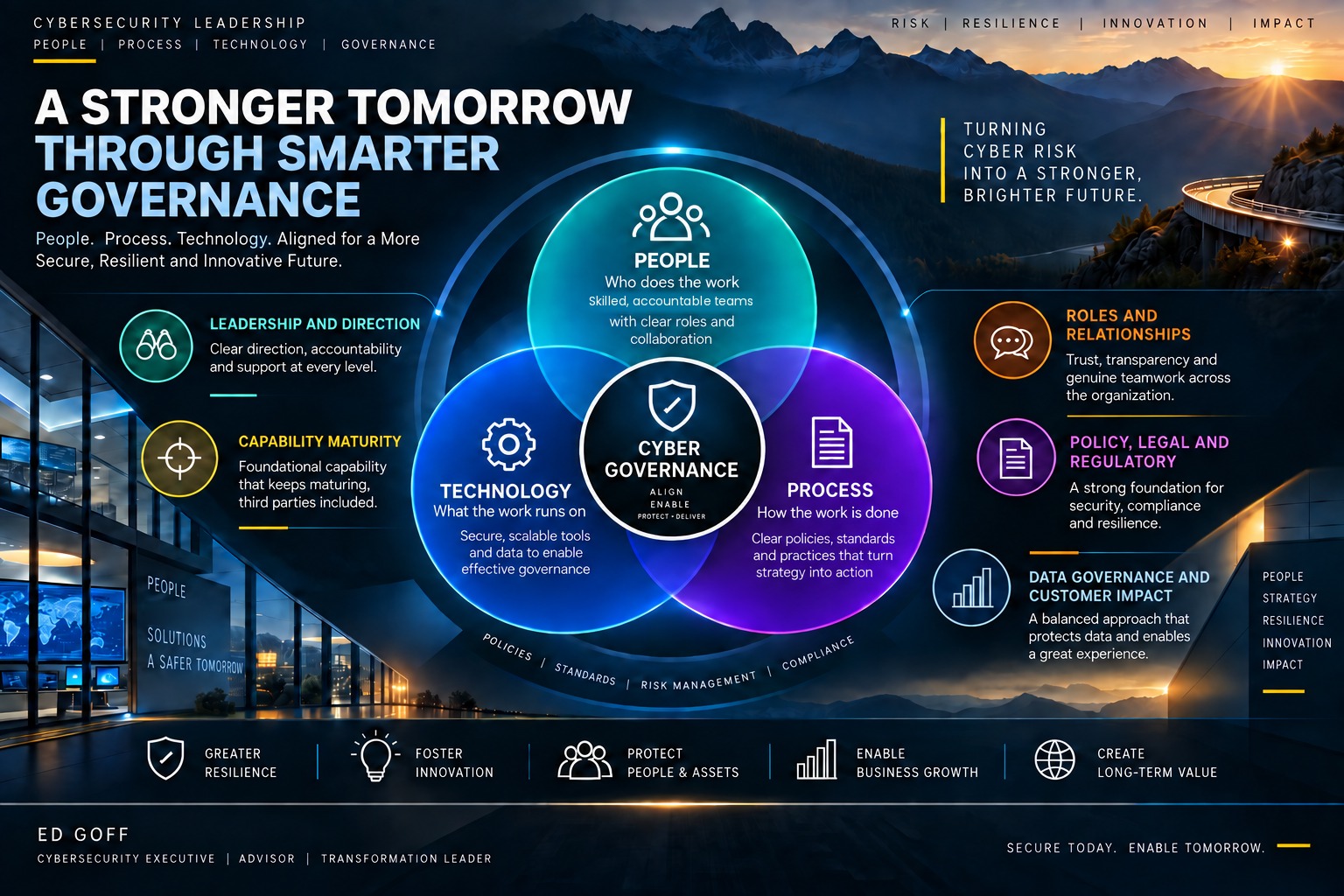
People, process and technology, organized around data, answers the third question - and it is the one governance programs skip. A program can name the right outcomes and the right owners and still fail, because the capability underneath was never resourced, the process was never written down, or the data it all depends on was never classified. Data sits at the center rather than beside the other three, because every governance decision turns on knowing what data exists, where it lives, and what it is worth.
The blended model
Stacking them is what makes them work. Each framework becomes a layer, and each layer answers its own question without pretending to answer the others.
Scroll the diagram sideways to see all three layers. Every dimension is listed in full below.
The eight dimensions
These are the eight I use, and the mapping I would apply today. Each is stated as a condition to sustain rather than a project to finish, because a governance dimension is never done.
Leadership and Direction
Senior leadership demonstrates the behavior, carries a clear vision for governance to every colleague rather than to a committee, and holds people accountable for their roles.
Governance and Oversight
Structures and processes built on accountability, action, assurance and advice. The governing body's own roles sustain integrity, leadership and transparency across the program, and they cannot be delegated into a function.
Policy, Legal and Regulatory
Policies and standards that are actionable rather than aspirational, enforced by technical control wherever that is possible, and written to enable the business rather than only restrict it. Policy is a guardrail, not a substitute for running the program it governs, and it fails when it is written as one.
Strategy and Investment
Real partnerships between business and technology stakeholders that translate business goals into multi-year cyber strategy, with matching investment plans and funding commitments that survive a budget cycle.
Capability Maturity
Foundational capability that keeps maturing, third-party partners and suppliers included, because governance can only assert what the capability underneath can actually evidence.
Operational Resilience
Cyber resilience planned across the enterprise rather than assembled from whatever each part of it happens to have written. This dimension reaches furthest outside the Govern function, and is the one most often left as a set of unconnected local plans.
Data Governance and Customer Impact
A working balance between governance and a good experience for internal and external customers, with data-centric capability treated as a foundation rather than a later phase. It decides whether the other seven can be evidenced at all: a governance assertion about data nobody has classified is an assertion about nothing.
Roles and Relationships
Clear functions, roles and responsibilities, carried by trusting professional relationships and communication that is sustained rather than announced. This is the only dimension that cannot be reorganized into existence, which is exactly why it belongs in the model rather than in a closing slide.
What the model changes in practice
A model earns its place by making decisions easier. These are the ones it makes, and the order they have to happen in.
- Adopt an outcomes framework formally, and say so in writing. Informal use of a framework gives you its vocabulary without its discipline. A governance policy and standard, formally issued, converts a framework into guardrails the business can be held to and can plan against.
- Split the what from the how, then move the how. The governing function owns what must be true. Whoever runs the program owns how. Anything the governing function performs rather than oversees transfers, with oversight staying behind. The test is blunt and it works: if the governance team would be the one paged at two in the morning, that activity is not governance.
- Publish roles and responsibilities. Not a chart. A statement of which function owns which outcome, which challenges it, and which assures it, in the terms of the accountability layer. Ambiguity here is what turns oversight into friction.
- Fix what reaches the board before fixing what reaches the dashboard. Board information assembled from sources that do not share definitions is worse than less information: it looks authoritative and cannot be reconciled in the room. Settle definitions with the technology and security leaders who produce the numbers, at the source, not in the deck.
- Measure the governance program itself, with automation. A governing function that only measures the programs beneath it has no evidence about its own effectiveness, and will be evaluated on volume instead.
- Give the relationship work the same standing as the structural work. Every item above can be executed correctly and still fail if the people being governed experience the result as control rather than support. That is a leadership obligation, not a change-management workstream.
A note on framework versions
I was making the argument on this page before the framework made it for me, and for a while the framework was an obstacle to it. Until early 2024, the version of CSF in general use held governance as a single category, ID.GV, inside the Identify function, which made it structurally awkward to argue that governance warranted outcomes and accountabilities of its own.
In February 2024, NIST published CSF 2.0 and made Govern a full function. ID.GV was withdrawn into it, and business environment, risk management strategy and supply chain risk management moved under it as well. The mapping on this page is to 2.0, because that is the version a reader will be working in, and because the restructure makes the case considerably easier to make than it used to be.
The three questions
The model reduced to something usable in a meeting. Take any activity a governance function performs and ask:
- What outcome is this producing? Name it in the framework's terms, not in the team's terms.
- Who is accountable for that outcome? One party owns it, one challenges it, one assures it, and none of those three is the same party.
- What capability sustains it? Which people, which process, which technology, and against which data.
If the activity cannot answer all three, it is not governance. It is work the governance team happens to be doing.
Where this applies
The model fits anywhere a function is accountable for security programs it does not operate. Federated global businesses. Groups whose divisions run their own technology. Post-merger organizations holding two stacks together while they converge. Any organization where a second-line function has been quietly absorbing first-line work because it had the skills and the access. The structures differ; the condition is the same one.
It is deliberately framework level, and it is a starting structure rather than an answer. Applying it means reconciling it against plans and initiatives already in flight, which in every case I have seen is most of the work and none of the diagram.
Grounded in
- NIST Cybersecurity Framework (CSWP 29), version 2.0, 26 February 2024. doi.org/10.6028/NIST.CSWP.29
- The NIST CSF 2.0 Core with withdrawn CSF 1.1 elements, NIST, March 2024, for the Govern categories and the disposition of ID.GV, ID.BE, ID.RM and ID.SC. nist.gov
- The IIA's Three Lines Model: An Update of the Three Lines of Defense, The Institute of Internal Auditors, July 2020. theiia.org
- Cybersecurity Capability Maturity Model (C2M2) version 2.1, U.S. Department of Energy, June 2022, as the instrument for measuring the maturity dimension. energy.gov
This page describes a reusable framework and the reasoning behind it. It names no client, employer, firm, regulator or individual, and reproduces no finding, recommendation or deliverable from any engagement. The patterns are general and stated as my own point of view. Every diagram here is original work. The Three Lines Model and the NIST Cybersecurity Framework are referenced by name and cited to their publishers; neither is reproduced.